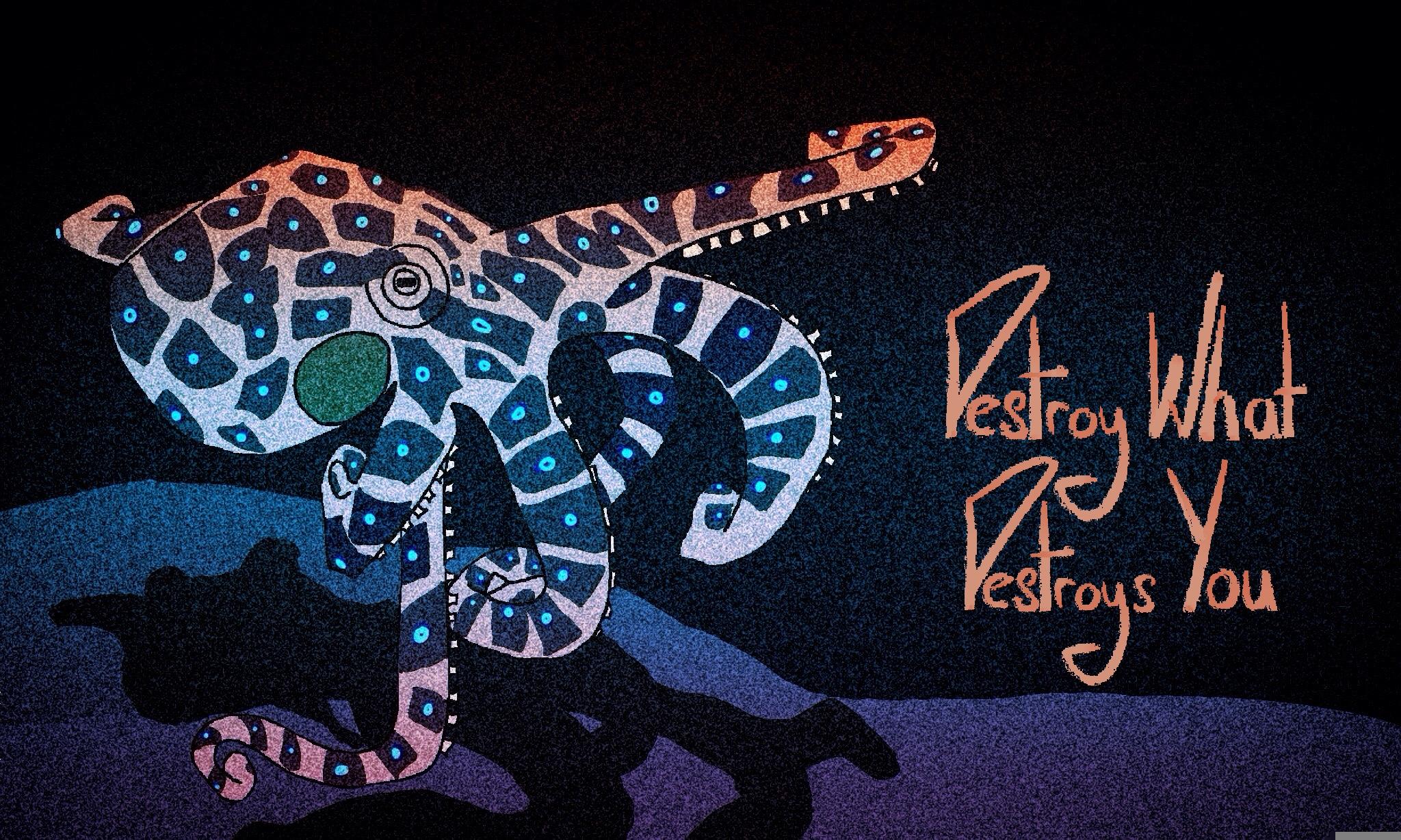
Audio-essay Part 1:
Audio-essay Part 2
–
Dykes, bitches, harpies, sluts! Every street is flooded with them! Overflowing! They fall down from trees as walnuts, burdensome with vicious promise: thunk, thunk, thunk, crash. They gush out from stinking gutters. They radiate out from the beams of street lights. Everywhere there are women: their voices, their faces, their hands, their teeth, their livers. Their intestines are lashing out from under porch steps with venomous fangs. Women’s screams condense the air into fog and the fog obscures the terrain. Everything that seemed transparent to power is rendered relentlessly opaque. No industry or agency can clear them away. No adequate form of containment can be imagined. Women laugh down the barrel of one gun, two, a hundred, and then three thousand. When one falls from a blast, 100,000 more women fly out from houses, from the muddy earth, from snowdrifts gritty with salt and oil. Suppressed spirits released from realms men assumed to hold them as fast as death. There is no armament impressive enough to keep them from laughing, from screaming, from wailing and wailing and wailing. Every agent is drowned in a cacophony, washed away in a flood of spit and mucus, piss and shit, blood and derision, chased down and destroyed by frost and by fire and by song, too.
–
Regime has escalated its ethnic cleansing campaign. This campaign is not new nor is it an aberration from the values and cultural practices that proceeded it, but it is a notable and undeniable escalation that calls for analysis, agitation, and resistance on every front. This is a campaign to remove people of color from social life: to extract value from them through a prison industrial complex revitalized by the ever-profitable distinctions between citizen and non-citizen. The definition of ‘citizen’ has always been malleable and, in the United States, carries an implicit whiteness which has made denying/revoking citizenship status exceptionally useful in efforts to mass incarcerate, maim, enslave, and ethnically cleanse racially marginalized people. It is a profitable system of devaluation and has been since its invention in slavery. To be subjected to its machinery is to be rendered disposable, reduced to raw material for production, consumption. Powerful men are enriching themselves even further by pushing more people out of center, out of borders, into precarity, into an ever-expanding margin. They are not inventing these methods from whole cloth. Just as other fascist regimes before them, they are utilizing structures that long predate either Trump administration to facilitate a radicalization process which, if allowed to continue, will conclude in another genocide.
Our context is in continuity with the past. Before this regime came to power undocumented people were hounded by border enforcement, kidnapped from their communities, tortured in concentration camps, trafficked to other countries, and murdered on public streets. Before this regime, mass incarceration was already status quo. Before this regime, people were shot by local cops and federal agents alike on false pretext. The United States is a project that began on the inheritance of thousands of years of patriarchy and authoritarianism and was founded upon and maintained by the genocide of Indigenous people, the enslavement of Black people, and a racial caste system that establishes white people at the top of a global hierarchy with propertied white men resting languidly at its uppermost pinnacle. Recognition of that history and how it shapes the conditions we fight today—that the state of things are in continuity and active relationship with the past—is paramount.
Our context is also an escalation from previous conditions. To acknowledge and understand the contours of that escalation appears just as vital. The machine is speeding up, heating up, billowing green smoke, launching tear gas cannister after tear gas cannister. It’s emitting a high-pitched whine that the previous engineers took at least some pains to keep quiet. It’s practically screeching. Steaming, obscuring the extent of its own functions (more and more, its malfunctions) to prioritize a fearsome performance. Its new operators think this is marvelous. This is, after all, why they started out by firing the engineers and all the other buzzkills. After destroying the perceived effeminacy of the cooling system, they’ve got big plans (Big Plans!) to cut out the brakes. This is how they signify that the machine is finally being run by real men. Real men stop for nothing.
We can trace both the influence of continuity and an emergent pattern of escalation from the arrests of pro-Palestinian protestors early in 2025 to the near indiscriminate harassment and kidnapping of people of color off the streets by the closing of the same year. Here is a process of a regime radicalizing. The ground prepared for them by the suppression of campus protests and thousands of pro-Palestine activists under the Biden administration, the second Trump administration practiced with Black and brown students and professors who agitated against genocide and the interests of their greatest vassal state, Israel. Mahmoud Khalil, Rümeysa Öztürk, and Badar Khan Suri were all documented and had no previous criminal charges before they were captured by border enforcement agents. To defend their kidnapping and incarceration, the regime invoked the Immigration and Nationality Act of 1952 to argue that the state could deport any immigrant—documented or not—if their presence is deemed to have serious negative consequences for U.S. foreign policy. This is notable not because this was the first time border enforcement has been leveraged to disappear organizers and suppress dissent—far from it—but this was an early moment in which this fascist regime flexed and tested its capacity to redraw the boundaries of citizenship. It was also an unveiling of the tactical-aesthetic for its agents that would appeal to the forces of kyriarchical reaction from which regime would frantically have to pull material and physical support to accomplish its goals: masked men decked out in military tactical gear springing from unmarked vehicles to kidnap people of color off public streets.
This essay is an endeavor to connect many of the fascist escalations we face today to their historical lineage, and, in doing so, uplift a corresponding continuity with the resistance of the past. The means of repression are not new, even if some of their forms may be novel, and neither are the most successful tactics in resisting enforcement. Though their use is undeniably expanding, the strategies deployed by ICE Watchers have long been used by communities of color—women and children of color in particular—to protect themselves from state incursion. Indeed, while this piece will explore a variety of current and historical conditions, its core concern is racially marginalized women and children—the means of suppression leveraged against them and the shape of their resistance to it—and it is to them it will relentlessly return. Patriarchy is a primary recruitment tool for border enforcement agents and gendered violence against their victims is ritual. Women and children’s vulnerability to border enforcement and the impacts of its operations on them are not incidental but intentional, and have a wider scope than is made visible. It is because of this that I locate them as the inventors, developers, and most skilled practitioners of the insurgent tactics used to disrupt campaigns of ethnic cleansing of the past and present. It is because of this, I argue, that the insurgent front is and always has been filled with women and children screaming.
Repression
Let’s begin by surveying the most recent escalations in the regime’s ethnic cleansing campaign. Border enforcement operations have ramped up nationwide and have been leveraged by the regime to undermine the political power of states with populations that resist its fascist projects, with the 3,000 agents deployed to Minnesota in “Operation Metro Surge” serving as a prime example. At time of writing in March of 2026, U.S. Immigration and Customs Enforcement (ICE) has captured and detained for deportation approximately 73,000 people: an 84% increase in its detained population in one year alone, and the most people detained by the agency on record. 32 people died in ICE custody in 2025—the most recorded in one year since the first year of the agency’s operation—and at least 13 more deaths in detention have been recorded in 2026 thus far. The records of those killed by Customs and Border Protection (CBP) are significantly more difficult to attain by design,[1] and even this inadequate and sabotaged data reveals the agency as the deadliest among federal law enforcement. Government officials suggest that at least 21 victims died in CBP custody in 2025 alone[2] and data gathered by the Southern Border Communities Coalition records at least 29 fatal encounters with CBP in 2025 including, but not limited to, those who died in their detention.[3]
While the violence is occurring with higher visibility and rapidity under the current regime, all of these cruelties and more were perpetrated by state enforcement agencies well before the Trump administration took power. 11 people died while incarcerated by ICE in the last year of the Biden administration. DHS has been responsible for the incarceration and displacement of millions in its 23 years of existence and 12 of those years—a majority—were under Democratic leadership. The total number of deaths directly caused by DHS’s border enforcement operations and its detainment apparatus since its founding is unknowable because their agencies have many strategies of underreporting, including the common practice of releasing dying people so they don’t have to put their deaths on record.[4] Further, the violence of arrest, the inherent stress of incarceration, the prolonged abuses in detention, the physical process of deportation and its isolating final result are debilitating to the extreme and inflict long-term mental and physical damage on its victims that are rarely measured: certainly never by the DHS, for whom deaths out of the reach of record is point and purpose.[5] This intent is demonstrated, too, in the deadliest and most bipartisan border enforcement policy—Prevention Through Deterrence—that has killed approximately 80,000 people attempting to cross the southern border in the last 30 years of its implementation.[6]
Impact goes wider than those who have been captured or killed by agents, wider even than the many thousands pushed intentionally to their deaths by border infrastructure. Migrant workplaces are among the primary targets of federal raids and serve a double-purpose of kidnapping key producers in migrant communities and keeping those they don’t capture from making life-sustaining income, which cause a cascade of effects that push them into even more precarity and vulnerability to border enforcement. Local economies grind to a halt and the effected can no longer afford food, medical care, or housing. Further, when people are taken, incarcerated, and trafficked to other countries, the roles they played in their communities and interpersonal relationships are left empty. Many of DHS’s victims act as the primary or even sole caretakers of vulnerable loved ones. When they are kidnapped, children are left neglected, are lost, are pushed into the foster care system. Disabled people are abandoned without the support they need to survive and their conditions deteriorate under stress and neglect. Ofelia Torres, only 16 years old, had her cancer treatments disrupted when her father, Ruben Torres, was kidnapped by border enforcement in Chicago on October 18th of 2025. In her online appeal Ofelia said her father “has been the main parent who watches my brother while I stayed at the hospital” and implored the public to remember that “immigrants are humans with families and deserve to be treated with love and respect.” In the following five months, while debilitated by the later stages an aggressive cancer, she acted as a fierce advocate for her father and others taken by federal agents. She was present at his hearings, including the one that occurred only three days before she died on February 13th of 2026. The life and death of Ofelia Torres and others like her who are killed by the actions of border enforcement will never make it into official state record. The greater burden of stress, its deleterious yet plausibly deniable impacts on health, and the legal processes’ incompatibility with the demands of the medical industrial complex are mechanisms of the ethnic cleansing campaign as surely as kidnappings, deportations, and direct killings are.
Perceived excesses of the regime cannot be blamed on a “lack of training” or slackened hiring processes. Jesus Ochoa and Raymundo Gutierrez, the two CBP agents who killed Alex Pretti, have been employed by the agency since 2018 and 2014 respectively. Jonathan Ross, the man who murdered Renee Good, served as a machine gunner in a combat patrol in Iraq from 2004 to 2005, then as a CBP field intelligence agent from 2007 until he joined ICE as a deportation officer in 2015. He trained other agents as well in his role as a firearms instructor. Far from the image of the “confused, inexperienced, untrained” agent that many liberals are blaming the extremes of border enforcement violence upon, he is the exact kind of man that agent training is designed to produce and more agents than Ross have used his tactics to murder people without consequence. There are numerous cases of Border Patrol agents intentionally and unnecessarily stepping in front of moving cars to justify using deadly force against vehicle occupants.[7] Agents on the southern border have been shooting rock-throwing teenagers to death when simply moving out of range would be trivial for decades.[8]
The recruitment posters of the past dared men to “Become a Part of the Legend.” Those of our time ask “want to deport illegals with your absolute boys?” Then, as now, there are men gleeful to answer the call. Dogs on the whistle. They were begging to be given the chance and they glory in it. When one man among them decides that a person is an insult to his authority, he can body that insult with violence and know that every man with him will back him up in his escalation, clap for him while his gun is still smoking. His own clenched fist magnified five-fold by men as power-hungry, as entitled, as willing to act on it as he is. It’s what patriarchy always promised him. He is finally home. To each other they chuckle, they cheer, they say “it’s like Call of Duty, right? So cool, huh?” That is, to each other they say it’s a game, a man’s dream finally come true: the trappings of power with little personal risk. What these men were only able to inflict on their tiny fiefdoms of the home—on the women they pursue, on the families they control—they can now play out on a massive scale with brothers-in-arms, on cities full of Non-Player Characters available to torment and destroy. In concentration camps that render those they capture into more easily exploitable resources. And through all of this earn the esteem of their brothers, the honor of their commanders, a game token, a pat on the back, a bigger and flashier gun.
Border Patrol in the United States traces much of its lineage to the 1823 founding of the Texas Rangers: an organization created foremost as a means to violently suppress Indigenous peoples, enable white slaveholders to colonize the land in service of an exploding cotton industry, and eventually to wrest control over the territory now known as Texas from Mexico. They fought in service of the earliest formations of the ethnic cleansing campaign that the state agents of today work to further industrialize, and were instrumental in the time period of U.S. history referred to by its survivors as La Matanza and the Hora de Sangre: when thousands of ethnic Mexicans were lynched and massacred in Texas between 1910 and 1920 to redefine citizenship and establish the foundations of the militarized southern border we contend with now. Describing the Texas Rangers’ massacre of 15 unarmed boys and men of El Porvenir in 1918, a woman who bore witness said “They had questioned no one at all, and their first words were threats.”[9] Tejanos in the borderlands were killed regardless of their citizenship status and retroactively labeled “bandits” or “bandit sympathizers” to excuse and further embolden their murderers. In this lineage, too, is Texan Governor James E. Ferguson ordering Captain Ransom of the Texas Rangers to “go down there and clean it up if he had to kill every damned man connected with it,” with the added reassurance “I have the pardoning power and we will stand by those men.”[10]
Evidently, neither CBP nor ICE nor any of their operations under the present regime are deviations from the lineage of border enforcement and the construct of citizenship in United States history. However, it is insufficient to critique these agencies in isolation and without naming the enemy in all forms of policing. The first official report from Berkeley Copwatch in April of 1990 could easily pass for a description of border enforcement operations in 2026: “They wear no identification badges and no numbers. Although they cruise in an unmarked car, they are not trying to hide the fact that they are police officers. They are, however, attempting to remain anonymous and therefore unaccountable. This is very dangerous and all citizens should be worried about Berkeley’s ‘Secret Police.’”[11] Every extreme of violence perpetrated by a border enforcement agent has a predecessor in police force: an institution older than the modern border with white supremacy, and anti-Blackness in particular, serving as its foundation. In 2016, Philando Castille was in his car with his girlfriend and child and posed no threat to the cops who stopped him, but still he was shot to death on the streets of a Minneapolis suburb and his killer was acquitted of all charges. In 2020, Derek Chauvin of the Minneapolis Police Department knelt on George Floyd’s neck for 9 minutes in front of a grocery store until he was dead: murdering him in daylight and in front of bystanders who recorded and begged officers to relent. Regardless of which administration is in power, police in the United States kill over 1,000 people every single year and incarcerate over 5 million.[12] Over 6,000 people die behind jail and prison bars annually.[13]
The lineage of police violence can be traced back into the earliest history of slavery in this country and sourced in the role of the slave catcher. From there it can be followed to anti-Black massacres and ethnic cleansing campaigns like those that were inflicted on the Black people of Memphis in 1866, Atlanta in 1906, and Tulsa in 1921. Just as the Border Patrol has done since its founding, police have recruited their officers from the ranks of white supremacist groups like the KKK. Just as Border Patrol has done since its founding, police act as occupying military forces to enforce and defend the structures of white citizenship. It appears misleading to refer to ‘policing’ and ‘border enforcement’ as separate and distinct phenomena when material reality demonstrates such a great deal of collaboration and overlap. Look to the 1930s, to the forced removal of over one million ethnic Mexicans from the United States. This white supremacist mass movement of the Great Depression involved the enthusiastic coordination of federal, state, and local government officials comparable to that seen today in the extensive joint operation (dubbed ‘Operation Tidal Wave’ by officials) taking place in Florida. Of that era was the 1931 raid of Los Angeles’ La Placita Park, when LAPD—in collaboration with border enforcement agents—blocked the park exits and detained the over 400 people there to be interrogated about their citizenship status. If this story seems familiar, it might be because of the October 2025 raid on La Catedral horse racing track in rural Idaho. The details are eerily similar: in a joint operation between local, state, and federal law enforcement, exits from the track were blocked and over 400 people were detained and interrogated about their citizenship status. Police involvement—then as now—is what makes many border enforcement operations possible. The 287(g) program, which saw a 950% increase in participating police agencies in the first year of the second Trump administration, makes the police’s de-facto deputization as border enforcement agents official and streamlined. More escalation within historical continuity.
We cannot stop short, as many do, of discussing patriarchy and violence against women, an undeniable unifying force among state agents and their most empowered enablers in society. An overwhelming majority of those employed by the DHS are men and the gender disparity is even higher among CPB and Border Patrol agents: men making up 81% and 94% of agency personnel respectively.[14] This is not an error to be reformed away, but instead a representation of men’s political investment that must not be ignored. It is to men’s affinity with authoritarian power and their desire to do violence in its defense that state enforcement agencies of all kinds appeal in their recruitment materials. Brotherhood in brutality and total protection from reprisal is the essence of what agents are offered for membership. Regardless of the gender of individual agents or victims, border enforcement agents are being recruited to do gendered violence and gender is present in every act of violence they commit. Under their power, all of their victims are gender marginalized and every gender marginalization is taken to its extreme. They use any means to deny the manhood of the men they capture, to remove its symbols and protections and thus mark them as targets for sexual violence. To the already gender marginalized, in every attack, violation, and privation by border enforcement is the message that under patriarchal rule Woman, whatever else it may be, is an assignment to disposability—to the subhuman—from which they will never be allowed to escape.
Before CBP agent Charles Exum rammed Marimar Martinez’s car and shot her five times in October of 2025, bodycam footage revealed one of the agents saying “do something bitch” while readying his firearm. In a Signal message afterwards, Exum told his buddies “I fired 5 rounds, and she had 7 holes. Put that in your book boys.” Jonathan Ross murdered Renee Good after both she and her gender-nonconforming wife demonstrated how little they respected his power, to such a degree they were willing to mock it to his face. As Good died, her car speeding into a crash, “fucking bitch” is spit after her. Within days and in the same city, Aliya Rahman, a disabled woman of color on her way to a medical appointment, was dragged violently from her car and detained by federal agents for the crime of becoming trapped in a ruthless double-bind: “Her only options were to move her car forward in the direction of ICE officers and risk being accused of trying to harm them — which led to Renee Good’s death — or stay stationary, which in the end led to physical violence and abuse.” Alex Pretti, a white man, was murdered by CBP agents after he had the audacity to act in solidarity with the women the agents were assaulting instead of seeing his interests aligned with the men wielding authoritarian power. In attacks by federal agents and within their custody—especially so in concentration camps—women are subjected to racial and misogynistic slurs and sexual assault.[15] Agent after agent asks, threatens, “Have you not learned your lesson when we killed that lesbian bitch?” Bitch, bitch, bitch, a staccato from lips cracked bloody by the Minneapolis winter. Unravelling like a machine gun firing: bitch bitch bitch bitch bitch.
The history of border enforcement’s violence against women is sparsely documented and under-examined. Women’s marginalization in the labor force and within the institution of the Family, alongside their connection to community and presence in public space, has made border enforcement operations against them look, at times, different than operations against men. Importantly, border enforcement’s operations against men cannot be meaningfully separated from their efforts to displace women. Patriarchy makes women economically dependent on their relationships with men and it is that vulnerability agents of white supremacy have long exploited. The phrase “You don’t buy from the husband, you buy from the widow,” was popular among white Texans during the decade of La Matanza, referring to the practice of executing Tejanos to coerce their wives into selling their property.[16] This practice has changed form but maintained its essence through history and to the present day. Formal border enforcement operations with a focus on detaining laboring men is a means to cut women and children—efficiently forced into precarity and dependence by patriarchy—off from many of the resources that make their lives possible.
Sexual violence against all of their victims has been routine for all of border enforcement’s history, and against the gender marginalized it is made ritual. Women’s contact with state agents has always been characterized by sexual violation and its consistency as a threat has loomed over every encounter.[17] An example of this in the historical record can be found in the 1910s, when the United States government erected the world’s first gas chambers using Zyklon-B (one of the many U.S. projects from which Nazis took inspiration). While utilizing racist propaganda that framed Mexican migrants as “dirty” and carriers of disease, the U.S. set up “delousing” plants at border entry points. At these plants migrants were stripped naked and searched for lice and if any were found they were forcibly shaved. Their clothes were steamed and drenched in chemicals, and the people themselves were gathered together—still naked—and sprayed down with a mixture of soap, water, kerosene oil, and Zyklon-B. On top of these horrific and dangerous indignities was an additional sexual violation for women, whose naked bodies border enforcement agents routinely photographed and posted on the wall of their local bar in El Paso.[18] The imminence of border enforcement violence also increases their victims’ vulnerability to domestic and sexual violence in interpersonal life, from which it ensures there are fewer means of escape. Abusers are well aware of the constant threat their undocumented victims live under, and use the threat of reporting to border agents to keep them entrapped. This precarity is so extensive that it can be leveraged coercively even in less intimate relationships, like those made at work or school. The apparatus of border enforcement diffuses and for the ethnic cleansing of racialized women and children a functioning limb of the border enforcement agent can be found abruptly reaching out from the torso of a landlord, a teacher, a social worker, a partner. Can be felt curling around them in family court or eviction court, every legal contact threatening to be the one that snaps tight, ensnares.
In a society structured around the supremacy of adults and the total subjugation of children, their vulnerability to state violence and their location as its primary targets cannot be overstated. It is this marginalization that allows border enforcement to use them as bargaining chips, blackmail, and hostages. Little Liam Conejo Ramos, only 5 years old, was used as bait against his mother: prodded by agents to ring her front door, and then sent to the concentration camp in Dilley, Texas where he became rapidly ill from the fetid water and rotten food served him. Liam was the fourth child in the Columbia Heights Public Schools district in Minneapolis to be kidnapped by federal agents, among them two 17-year-olds and a 10-year-old abducted on her way to school. Federal agents have lurked near bus stops and have had to be chased from school parking lots. In the first year of the second Trump administration, border enforcement has kidnapped at least 3,800 children under age of 18, including 20 infants. More than 1,300 have been kept incarcerated over the 20-day maximum limit mandated by the Flores Settlement. A majority of the children detained by ICE in 2025 were eventually deported.[19] Infants, toddlers, kids, teenagers, ICE kidnaps them all without hesitation and with a family member if they can. An adult who may sustain abuses to their own bodies for longer in the hopes of legal aid and escape from deportation will have a more difficult time holding out if they also have to watch a child they love suffer and wither. This is the operating logic of family detention.
This, too, exists in historical continuity with border enforcement operations of the past. Every policing and border enforcement entity in the history of the United States has engaged in ritual abuses of racially marginalized children and used them as leverage against their loved ones. The fate of marginalized children—whether they will be erased via massacre, displacement, neglect, or indoctrination—has been among the primary concerns of every ethnic cleansing campaign. Using children in the way federal agents used Liam Ramos against his family members has always been common practice. In the 1970s, “Border Patrol agents also used the children of migrants, either as bait or as a pressure tactic to force confessions. When coming upon a family, agents usually tried to apprehend the youngest member first, with the idea that relatives would give themselves up so as not to be separated.”[20] When a third of the ethnic Mexican population in the United States was forcibly expelled from the country during the Great Depression, a majority of the victims deported were children.
Kyriarchy is what connects all of these systems of oppression and their every expression: the values system of authoritarianism and the practices that make it a social reality, powerful among them those that constitute white supremacy and patriarchy. The systems that interlock in such a way to make prisons, borders, police, and military force possible, able to cohere into a material fact that debilitates and kills. That which sorts human lives into a hierarchy which enriches a shrinking center by dining on the ever-widening margins. It assigns value to or strips it from human lives through constructs of gender, race, ability, citizenship status, and more: all of which have meanings that are easily subject to change when advantageous to privileged castes. While administered and resourced by the mechanisms of State power, its values proliferate throughout all social relations in the hierarchy, protecting itself by handing out different stakes in its success. By these means it can generally depend on people throughout the hierarchy to prioritize their own positions (some with aspirations to rise in the hierarchy, and many others only desperate not to fall further below) and thus become collaborators in the larger system’s maintenance. White people are called upon to defend white supremacy, to fill the ranks required to launch new ethnic cleansing campaigns, to defend the property accumulated through centuries of imperialism, enslavement, and genocide. Men dutifully volunteer to the service of patriarchy and drape themselves in its honors every time women—as a social group or as individuals in their personal lives—seem to be transcending the roles men designed for them. Adults render children into property to be leveraged and a commodity to be exchanged. People of all social positions and identities are subjected to extensive propaganda that incentivizes them to see their interests, their visions of success, their very sense of self tied to the pursuit of power and control.
Resistance
Songbird, insurrectionary, versed in asymmetry.
Into her neighborhood there glides a hawk to hunt, to take, to devour, digest. There it is, that mass fast approaching over the ridge. Do you see it? Well. It’s been seen, and that’s all that matters.
A whistle carries farther than a shout, and clearer too. There it is, her soprano pitch the first alert. Did you hear it? Well. It was heard, and that’s all that matters. All around us now rises the choir. They’re collecting themselves into an ocean wave. They’re going off as a riot. Do you know what people call a group of smaller animals that mobilize like this against a predator? There’s always someone ready to declare them a mob.
The mob has surrounded the hawk now. Surely, it’s been only moments since his arrival? They’re barring his path. They’re screeching in his face. They’re plucking his feathers. They must even be disturbing the flow of the currents his flight depends on. Yes, see, he’s straying off-target. Great wings lilting awkwardly down and to the right.
He screams, hollers, thrashes, threatens. He lashes out and sometimes (oh, yes, sometimes) he snaps a songbird’s neck in the guillotine of his beak. But often (yes and more often still) feasts only on empty air.
Songbird, insurrectionary, versed in asymmetry.
She and her neighbors know that only harried hawks go hungry.
–
As repression has escalated, so, too, has resistance. “Operation Metro Surge”—which deployed approximately 3,000 federal agents to Minnesota—was extreme, violent, devastating, and also wildly inefficient. For all of that ground force, which could only be mustered by begging volunteers from other enforcement agencies, they were only able to make approximately one arrest per-agent in three months of intensive occupation. This is because their incursions have been met with ferocious resistance: masses of people determined to hamper every minor movement of the regime, to toss a wrench into every gear. Operations that previously required only a few agents are now requiring a dozen or more. Even a platoon of ICE agents cannot guarantee success in places where resistance to them is widespread and passionate, and federal agents remain dependent on the isolation of their targets and the element of surprise in order to carry out their operations. When they are confronted directly, immediately, and loudly they are often forced into a hasty retreat, their body armor and munitions made meek and ridiculous. Costumes of war absurdly ill-suited to the battle at-hand, and costly besides.
Countersurveillance of agents and direct obstruction of their operations—popularly known as ICE Watch—are among the more visible acts of resistance to border enforcement. There are large and decentralized networks of people who work to track and report border enforcement vehicles, follow and disrupt agents in their operations, and warn vulnerable people to their approach so they might avoid capture. This tactic becomes more effective the more people in the community are prepared to be involved on spontaneous notice. One scream or one whistle quickly becomes five, then ten, then thirty within moments. People fly from their houses and into the snow half-dressed to heckle agents, kick their cars, pelt them with snowballs, block their path. Countersurveillance is deployed by ICE Watchers to uncover the identities of individual agents and make them more vulnerable to reprisals. Where border enforcement agents live, eat, sleep, ICE Watchers endeavor to disrupt, to hound them right out of their uniforms, to chase them all the way back home and, even there, to never allow them a moment’s rest from screaming. Not to be missed are the various attacks on and disruption to border enforcement infrastructure. Here are efforts to block their vehicles from returning to their buildings. There, an attempt to harass an ICE contractor away from providing a plane, a bus, a fence, a room, a meal. Another agitates against local police involvement in the 287(g) program. There’s someone setting fire to a warehouse that’s under consideration as the site for a future concentration camp: but shh, if anyone asks, we didn’t see it happen.
Concurrent and of equal importance to ICE Watch tactics, though necessarily less visible, are the strategies that provide care to border enforcement’s targets outside of state and capitalistic structures that increase people’s vulnerability to policing operations. People who are trapped in hiding from an ethnic cleansing campaign need food, clothing, housing, protection from eviction, medical care, schooling, and more. Many networks with a focus on caring labor have to practice extreme caution: any errors with informational security could inadvertently lead agents to the very people these networks exist to protect. People in Minneapolis involved in grocery runs to those in hiding share a practice of writing their addresses down on pieces of paper they can quickly eat if stopped by agents. To get children to and from school there are adults stationed on every corner, ready to shout the warning and move with rapidity to get them to cover and safety. School bus drivers deny agents access to their vehicles. Teachers ready to defend their classrooms from raids. With border enforcement stalking hospital and clinic parking lots, alternative forms of medical care have been mobilized and strengthened. Participating healthcare laborers are finding themselves engaged in a more holistic service than the medical industrial complex ever allows: doing home visits, bringing groceries along with medicine, their medical vans doubling as buses to take children safely to their classes.[21]
When oppression has a lineage that can be traced and learned from so, too, does resistance. There has never been nor will there ever be an oppressive force without challenge, even as certain forms of resistance have gone undervalued and unrecognized. An authoritarian must always be engaged in counterinsurgency, their target always in some way insurgent, that is, always resisting being rendered into an object marked for extraction and consumption. Because of this, historic tactics of disruption and resistance are there to nourish the insurgents of the present and to be adapted to our conditions. ICE Watchers did not invent the strategies they are mobilizing to defend against this campaign of ethnic cleansing, nor are current ICE Watch tactics their most militant expression. Most, if not all, of the tactics leveraged against border enforcement have precedent in centuries of agitating against police enforcement, incarceration, slavery, and the anti-Blackness that conditions them. Strategies of countersurveillance deployed to such effect today—physical witnessing, digital witnessing, documenting abuses, broadcasting them strategically to mobilize others against regime—have Black women as their most likely inventors and certainly their most dedicated practitioners: “from Ida B. Wells’ systemic documentation of white mob lynchings in the late 1800s to Darnella Frazier’s 2020 recording of George Floyd’s murder, which sparked international protests against police violence, black women have occupied the role of witness for others experiencing state violence.”[22] From the first acts of resistance to enslavement to Black community defense under the boot of Jim Crow to the Black Panthers ‘policing the police’ to the uprisings in Minneapolis in 2020 in response to the murder of George Floyd, it is evident that a great debt is owed to the influence of centuries of Black Liberation movements. Every such movement has had to engage in a conflict of extreme asymmetry, has had to do so while being utterly denied the power and privileges of white citizenship, has by vital necessity developed various and nuanced strategies to resist state violence, and has creatively adapted previous ones to their own context.
ICE Watch could not exist in its current form without Cop Watch. With the increased attention and participation ICE Watching is receiving it is especially vital to connect the movement against border enforcement to the struggle against police power and resist every attempt made to distance the two. In part because, as previously established, there is no meaningful distance between border agent and police officer to justify such a distinction. Police have always acted as border enforcement agents and that aspect of their role is becoming even more explicit. Further, looking to the lineage of copwatching gives context to the strategies being deployed and situates them appropriately in relationship to the wider struggle against white supremacy. The tactics of physical witnessing and mobilizing others for community protection against white supremacy predates any project that developed those tactics in formal organization: when there is a threat, it is an old and steady logic to set up a Watch. Formal organization for this purpose, however, is still many decades old and has its precedent in the militant self-defense of Black people. The Deacons for Defense began their first chapter in 1964 to protect local Black people and civil rights organizers in the South from attacks from the police and the KKK. They acted as an armed presence to dissuade racist violence and defend against it when necessary, stood guard at the homes of especially vulnerable people, acted as secure transport for endangered organizers, and served as an organizational model for the founding of the Black Panther Party in 1966.[23] The Panthers showed up to police encounters with lawbooks as well as arms while other parts of their programs focused on providing food, medical care, and education to Black communities. In late 1960’s Minneapolis, the American Indian Movement, Black Power, and Chicanx liberation groups organized their own patrols (the Black Patrol, the AIM Patrol and the Brown Berets respectively) to challenge police and white vigilante violence against their communities.
While there are undeniably women who are also mothers on the front of the struggle against regime, it is unsettling how all adult women active in resistance are often assumed to be ‘moms’ without direct cause. It often seems as though a woman might only be celebrated as a valid participant in struggle if her success in the institution of the Family can be imagined, if they can hear her screams as an echo of a husband, or perhaps a son. It tells an old story. It tells much the same story federal agents and cops narrate when they crack a woman’s ribs, when they take out her eye, when they kidnap her loved ones, her liberty, her life: that a woman’s place under patriarchy is in confinement and her life is defined by roles. Which is why more can and must be said about women specifically. Unmatched are women’s voices and tactics and they are to be found on every front. In nearly every viral video of resistance to border enforcement a woman’s voice pitches up above all the others to scream in anger, in rage, in grief. Women are racing behind agents in their cars and, when those cars are wrecked, they climb into another woman’s car to act as navigator. Women are mobilizing complex social networks they have been part of for decades, redesigning them utterly for the sole purpose of community defense and fighting regime. Women are creating entirely new networks in one instance, dissolving their formation in the next, and suddenly reappearing on a different line of attack. Women know that these tactics are incomplete without care: without food, housing, and medical care provided by mutual aid. Women know this not because of some inherent instinct towards caregiving, but because in a world dominated by men knowing these things is the only way to survive on the gendered margins. Women know how to ask the important questions that men—including those amongst their comrades—have generally neglected to consider all their lives: how do you feed people under attack? How do you get children get to school, especially when doing so risks violent harassment? How do you make sure someone in hiding is getting necessary medical attention? How might one avoid or be protected from a determined stalker, especially when that stalker is on friendly terms with the local cops? What kind of information or patterns of behavior seem benign, but ultimately risk the safety of someone vulnerable? How do you resist under a system of extreme surveillance, under the constant threat of debilitating violence, and within an entrenched asymmetry in power?
Few women are better positioned to challenge regime narrative than the women of color who have survived the extremes of its deprivations and violence. Marimar Martinez followed Border Patrol in her car—horn blaring, screaming “¡la migra!,” and successfully warning a migrant landscaping crew of danger’s approach—for 20 minutes before agent Charles Exum rammed her car and shot her 5 times. In the aftermath of the shooting, regime lied and claimed that Martinez had rammed the agents’ car, declared her a domestic terrorist, and charged her with assaulting the officers. Describing her choice to follow the Border Patrol vehicle when it crossed her path, Martinez said, “You just grow tired of living in fear, and, you know, I saw my opportunity.” Seeing and taking opportunities to agitate against regime is what she has continued to do since she survived attempted murder. “Agent Charles Exum. Charles Exum. My attempted executioner was Charles Exum […] I think it is important now that the truth of this case is exposed that people know his name. Charles Exum.” She is a survivor who knows the importance of naming names, of countersurveillance, of exposure, and of remembering the dead: “Renee Good, Alex Pretti, Silverio Villegas Gonzalez should all be here today.”[24] Emphasis on historical continuity and pattern in particular is center in Aliya Rahman’s testimony: “not all autistic brains do this, but mine fixates on sounds, numbers, and patterns. In that moment the pattern felt very strong to me, and I thought of Jenoah Donald, an autistic Black man killed by police during a traffic stop in 2021. I remembered Mr. Silverio Villegas Gonzalez, who was killed by ICE in his vehicle last year […] when I hit the ground and people leaned on my back. I felt the pattern and thought of Mr. George Floyd, who was killed four blocks away.”[25] Rahman, like Martinez, reflects a sense that survivorship comes with a special responsibility. Or perhaps, more accurately, surviving extreme violence gives one special knowledge (perhaps most poignantly of those who haven’t survived) that compels many survivors to hone their own voice and project it. To wage insurrection on the public record. To let no one forget that violence is taken to its furthest extremes behind closed doors, especially behind the doors of the prison and the concentration camp.
A prominent survivor of the earliest escalations of border enforcement under the Trump administration, Rümeysa Öztürk, reflects the same priorities in “Even God Cannot Hear Us Here”: What I Witnessed Inside an ICE Women’s Prison. In this piece, published two months after her 45-day incarceration in the South Louisiana ICE Processing Center, Öztürk prioritizes the over 900 women incarcerated there whose cases are not granted the same resources of her high-profile one. She details not only the horrific, torturous conditions in the concentration camp but also, emphatically, the love and acts of resistance to be found among incarcerated migrant women. “I found myself immersed daily in the love, beauty, resilience, and compassion of these women. We each found ourselves trapped in our own individual nightmares, but we found comfort and relief in one another, and we shared the burden and pain by listening to each other.”[26] No analysis of women’s resistance can be complete without accounting for the everyday revolts waged by incarcerated women. It is on this terrain, where power asymmetry is most extreme, that the essentials for insurrectionary action are most evident. Where neglect unto illness or death is policy, care is resistance. Incarcerated women share sparce essentials with one another, provide medical care, tell stories, analyze politics together. They adorn each other in lovingly crafted jewelry even though guards are sure to steal and trash them, and do it again the next day. Even when the women appear their most apathetic and disengaged—“I remember seeing women cocooned in blankets, resembling lifeless figures as they finally managed to catch some rest in the late afternoon. Young, beautiful women seeking refuge in sleep, just to cope with their harsh realities, dreaming of freedom, loved ones, and moments of safety”—they are resisting with ferocity.[27] In an environment of such extreme deprivation, even cocooning oneself in a blanket for the afternoon is a radical assertion of autonomy: getting sleep when it is undermined intentionally, obscuring surveillance, abstaining from the routinization of incarceration. Insurrection is encoded in the incarcerated woman’s every unsanctioned gesture.
Women’s solidarity with each other has long shaped the history of resistance against border enforcement. Look back to 17-year-old Carmelita Torres and the women with her who launched the Bath Riots of 1917 against the forced stripping and dangerous gas baths required of Mexicans crossing the border into the United States.[28] Torres had heard warnings through women’s whisper networks of routinized sexual violation—of agents taking photos of naked women and posting them at local bars—and the dangers of the chemicals used. When agents stopped the trolley car Torres and other women were taking to work and demanded they submit to “disinfection,” Torres refused and urged the 30 other women of her car to do the same. They hurled insults at border agents and laid their bodies on the trolley tracks. The number of participants surged to over 100 within the hour and attempts at suppression were met by women’s joyful derision. A report from the El Paso Times described the scene: “Carranza cavalrymen were unable during the morning to make any headway against the crowd, although they drew their sabers threateningly. Women laughingly caught their bridles and turned their horses aside, holding the soldiers’ sabers and whips.”[29] By the afternoon, the women’s forces had expanded to several thousand. They seized the trolleys. They shut down the border. They pelted racists with stones. They broke apart cars and used them to block the Santa Fe Street Bridge: “As soon as an automobile would cross the line the girls would absolutely cover it. The scene reminded one of bees swarming. The hands of the feminine mob would claw and tear at the tops of the cars. The glass rear windows of the autos were torn out, the tops torn to pieces and parts of the fittings, such as lamps and horns, were torn away.”[30]
Carmelita Torres, a teenager at the time of her historic refusal, and the Bath rebellion demonstrate the impossibility of separating women’s rebellions and children’s revolts. It is difficult indeed to find a women’s revolt free of children’s influence, and just as rare to see a children’s revolt without the support of women. However, focus and celebration of children’s resistance in particular is paramount and we are far from wanting in examples today. Look to the Dilley children’s revolt that was launched from the inside the South Texas Family Residential Center, the United States’ largest concentration camp for children and their family members (predominantly women, as men are in most cases separated from their families entirely). News of the revolt was carried out of the prison on the power of children’s screams. This is the same concentration camp is where Liam Conejo Ramos and his father were sent after they were kidnapped and where thousands of other children have been incarcerated since it first opened in December of 2014. In solidarity with Liam, on January 24th of 2026 dozens of children initiated a protest from within the concentration camp: they gathered together in the yard of the prison and screamed! They screamed “Let us go!” They screamed, “¡Libertad!” They screamed without words, with fear, with rage, and—at their center—with a determination to disrupt. It was their screams that alerted someone with access to the outside world to the protest. Immigration attorney Eric Lee was rushed out of the camp due to what guards referred to only as an “incident.” The incident became unambiguous as soon as Lee stepped into the open air, into the overwhelming sound of children wailing.
Outside of the camps, too, children are active against regime and border enforcement. Teenagers, many freshly licensed, are following ICE agents in their cars and participating in every aspect of ICE Watch that adult activists are. They’re organizing massive strikes on their schools. They’re hounding cops and border enforcement agents on their skateboards. Their hands are the first to start erecting barricades. They are not the passive recipients of charity, but are at the forefront of countless projects for mutual aid. Migrant children with citizenship status are—as they have had to long before the current regime—strategically engaging with systems on behalf of undocumented family members to shield them from additional vulnerability. They’re acting as interpreters. They’re using themselves as distractions to lure border agents away from their loved ones. When captured, they engage in other types of refusal. They withhold their cooperation and undermine attempts to reduce them to pawns to be used against others. They’re thrashing against their bonds, they’re screaming, they’re crying, they’re making a scene. This is not an innate instinct let loose, but an intentional tactic leveraged in response to an asymmetry of power. It is a strategy that has served children well in revolt for centuries.
And there children are: resisting ferociously back through time. There, too, their screams are acts of insurrection, a call to arms, a means of exposing state violence. In a 1953 memo from Border Patrol inspector David Snow, he complained of women and children using the “professional method” of making a scene to avoid capture or free themselves from it. As Kelly Lytle Hernández details in her history on U.S. Border Patrol: “Upon apprehension, [Snow] explained, children would ‘immediately begin to cringe and cry.’ In the public places where apprehension quite often occurred, the ‘shrieking’ and ‘struggling’ of children who had been grabbed by Border Patrol officers often forced the ‘embarrassed officers’ to set the children free […] The public resistance of rebellious women and children turned U.S. Border Patrol officers enforcing federal law into men embarrassed by their mandate and created what Snow described as a ‘spectacle’ that was becoming an ‘untenable situation’ for the U.S. Border Patrol.”[31] It is the same strategy, combined with countersurveillance, that was leveraged by the three daughters of Perla Morales-Luna as CBP agents dragged their mother into a van in March of 2018. One of the girls recorded while they all screamed in distress, cried, called for their mom, begged the agents not to take her. It was their willingness to make a scene, to make state violence apparent, that brought others nearby to the mother’s defense as she was taken and even more to her aid when their video was shared widely. Their mother’s later release can almost entirely be credited to her daughters’ fierce resistance on her behalf.[32]
Youth are not only spontaneous insurrectionaries, but dedicated organizers with a special talent for striking. The frequency and scope of school walkouts in only the first few months of 2026 are incredible but not unprecedented, especially as a tool of resistance to white supremacy and border enforcement. For a full week in March 1968, in what would come to be known as The East Los Angeles Blowouts, over 22,000 Chicanx students walked out of their classrooms to protest racist disparities in their education. There we find another example of the inseparability of children’s and women’s resistance: when Roosevelt High School locked their fences to prevent students from leaving, Vickie Castro used a chain and her old Mazda to pull the fence gates down and free them.[33] In 2006, again in LA, Chicanx students organized another walkout of over 40,000 participants to protest a bill that would have made attaining legal residency more difficult, criminalized migrants and anyone who aided them, and likely result in mass deportations. The influence of this lineage can be seen in the militant student strikes that have taken the streets of LA repeatedly since the beginning of the second Trump administration: “Unencumbered by formal speeches and megaphone-driven chants, the participants have instead spent their time setting off fireworks and smoke bombs, doing burnouts at intersections, and chanting “Culero!” at the cops. Anger, frustration, excitement, and joy have mingled in the streets as cumbias and corridos blast from car stereos and live bands and the smell of burning rubber fills the air.”[34]
Here is another era of children’s revolts. Like throughout recorded time, children are the unrecognized militants of the front, in many cases taking insurrectionary initiative well ahead of their adult comrades. They are among border enforcement’s prime targets and their greatest enemies. Youth are defecting from the institutions designed to contain and indoctrinate them and they are using this flight to agitate on a wider scale. They’re pouring out of high schools, middle schools, elementary schools, kindergartens, and into the public spaces that have been forbidden to them. They are remaking the commons by the force and audacity of their presence. Paint drips from the tips of their fingers and splatters with their every gesture. Window glass disintegrates in their passing, like the buildings became suddenly ravenous for air. Anarchism blooms in the shade of their heels. It’s trying to catch a ride on the gum stuck to the bottom their shoes. When man tries his violence on them, children swarm him like ants in a fury. There’s one boy with his arms tightly latched—a vice around the man’s fragile neck. Don’t you hear the vertebrae cracking? There’s two kids—no, five now—clawing at his face, pulling out his teeth, plunging anxiously bitten nails into the jelly of his eyes. Look there, it’s the girl the man struck first: now she’s tearing the paper of his lungs between her hands like a contract voided.
What the Patriarch Fears
Border enforcement of the past developed strategies of counterinsurgency in response to the effective resistance of their targets. The policy of Prevention Through Deterrence has been priority over the decades because border violence made visible, public, and disturbing diminishes public image and logistical efficacy in a way that thousands dying quietly in the most hostile stretches of the borderlands does not. This regime’s changes in prioritization in border policy are profoundly frightening, and the devastation already caused is incalculable. But in its escalations, too, are great weaknesses that are being exploited by audacious insurrectionaries even as this is being written. Regime’s preferred tactics require a ground presence it must pull from many other areas and agencies to provide. Their threats are endless and extravagant, but not every threat is acted upon, nor is it ever performed with the efficacy and strength their rhetoric suggests. They have been pushed back from territory they claimed to have clenched in their fist for all time. In a regime of showman, of reality tv show stars and podcasters, it remains important to not let their performance lead us and to instead use our own analysis to understand the terrain of conflict.
In that terrain, women and children of color are vigorously targeted and to be found on the front of the most militant acts of resistance. The way regime targets them specifically demonstrates how intertwined the political projects of white supremacy and patriarchy are in the United States, how instrumental they are to the radicalizing fascist regime, and how vital it is that their every expression be attacked. The way women and children insurrect against oppression—when every battle is marked by an extreme and deadly asymmetry—is not merely something to be intentionally learned from, but a fact that has already shaped the nature and scope of resistance itself since the first authoritarianisms took material form. Behind every successful ICE Watcher tactic is a lineage of racialized women and children’s insurrectionary praxis. There is no front in the struggle against regime they cannot be found, though too rarely are they sought after and more rarely still are they truly seen. Seen or not, there they are. Their voices can be heard pitching high, angry, fearful, and utterly determined at every action against border enforcement and ethnic cleansing. Survivors of state violence emerge and sing much the same song, though perhaps in a different key. The women and children still locked away in concentration camps sing it, too. Some days they may only whisper the tune: its melody only hinted on a gasping breath, a secret passed slyly between trembling hands. Other days, they, too, are screaming it. It’s the kind of insurrection that makes even prison walls—if only for an afternoon—a kind of permeable.
The Trump administration has abandoned many effective strategies of counterinsurgency: declared them boring and weak and fired everyone who might say otherwise. Rather than carefully framing the insurgent as inherently separate from civilian, they declare entire city populations insurrectionaries who must be dealt with in force. They encourage their agents to indiscriminate deadly violence by offering them public support and private promotions like the one offered to agent Charles Exum only hours after he shot Marimar Martinez. They act as if there is little substantive difference between the public, insurrectionaries, and the people they’re targeting for ethnic cleansing. Because of this, the costs (economic, logistical, and to agent moral) of their operations will only increase. By depriving citizens of liberal, non-confrontational means of protesting while also invading the public spaces many of them expect safety and stability in (schools, churches, hospitals), the fascist regime forces more people into postures of direct, anti-state action as well as into closer proximity to more radical movements. All things that decades of U.S. military counterinsurgency theory warns to avoid at all costs. It makes for a shockingly violent and theatric oppressive force, but not for regime stability.
Regime teeters and wobbles under its own awkward weight, top heavy, with a core they continue to foolishly hollow out as effeminate waste. It’s put all of its power into arms, arms so bulky they cannot touch their own shoulders, cannot even adjust the tin crown upon the withering head. Women and children know what do to when the patriarch is off-balance: push. The ways to push are many, most covert, all insurgent. Remove the air from his tires or the oxygen from his blood. Tangle his shoelaces, sabotage his meals, set fire to his bed. Look out for him and scream when he approaches. Spit in his face. Dig your teeth into his ankles. Slam the door on his fingers and barricade against his movements. When he comes for the children, the women bait his attention. When he comes for the women, the children do the same. When he comes for anyone, he comes into a decentralized mass of rage, into a chaos of directionless wailing that makes his ears bleed and his stomach turn traitor. He came here to professionalize his hatred of Other in bloodsport and instead he finds evidence of a fact he has always feared though he’s been sheltered from it all his life: women and children hate him profoundly, have always hated him, and are always waiting for the right opportunity to undo him. Here he comes into direct contact with the truth of his power: it is the only thing protecting him. And everywhere around him the promised strength of its structures is giving way. His greatest terrors are manifest. One day all the power he will have left will be the power of his gun, and what does it mean for him that women and children don’t run from those the way they used to? The implications make him tremble in his Kevlar. His great arms thrash about and his vast fists clench, but again and again they close on nothing.
The zine version of Songbird, insurrectionary: continuity and escalation on the fronts of border regime can be downloaded on the Zines page of this site, or from my ko-fi shop with the option to donate (50% of the proceeds of the proceeds from ko-fi sales will go to No More Deaths/No Más Muertes, who you can donate directly to here.) The audio version can also be listened to on the Butch Anarchy Podcast.
[1] Deaths, No More. “US-Mexico Border Death Map and Database.” No More Deaths • No Más Muertes, 4 Aug. 2025, nomoredeaths.org/us-mexico-border-death-map-and-database/.
[2] CHS Letter to Noem Re Ice and CBP Condemning Deaths, 22 Jan. 2026, democrats-homeland.house.gov/imo/media/doc/chs_letter_to_noem_re_ice_and_cbp_condemning_deaths.pdf.
[3] “Fatal Encounters with CBP.” Southern Border Communities Coalition, 16 Mar. 2026, www.southernborder.org/deaths_by_border_patrol.
[4] Bryant, Erica. “Ice’s Deadly Practice of Abandoning Immigrants with Disabilities And…” Vera Institute of Justice, 1 Sept. 2021, www.vera.org/ices-deadly-practice-of-abandoning-immigrants-with-disabilities-and-mental-illnesses-on-the-street.
[5] “Report on Health Impacts of Deportation.” No More Deaths • No Más Muertes, 16 Dec. 2012, nomoredeaths.org/report-on-health-impacts-of-deportation/.
[6] “Left to Die: Border Patrol, Search and Rescue, and the Crisis of Dissapearance.” The Disappeared Report, 3 Feb. 2021, www.thedisappearedreport.org/uploads/8/3/5/1/83515082/left_to_die_-_english.pdf.
[7] Hsieh, Steven. “US Border Agents Intentionally Stepped in Front of Moving Vehicles to Justify Shooting at Them.” The Nation, 28 Feb. 2014, www.thenation.com/article/archive/us-border-agents-intentionally-stepped-front-moving-vehicles-justify-shooting-them/
[8] Gaubeca, Vicki B. “Why Is U.S. Border Patrol Shooting Rock-Throwing Teenagers?” ACLU of Texas, 13 Mar. 2014, www.aclutx.org/news/why-us-border-patrol-shooting-rock-throwing-teenagers/.
[9] Soodalter Ron Soodalter is an award-winning author, Ron. “‘Killed Without Cause’: The Century-Long Battle to Hold the Texas Rangers Accountable for Their Role in the Porvenir Massacre.” Progressive.Org, 10 Aug. 2023, progressive.org/magazine/killed-without-cause-soodalter-20230809/.
[10] Martinez, Monica Muñoz. “Recuperating histories of violence in the Americas: Vernacular history-making on the US–mexico border.” American Quarterly, vol. 66, no. 3, Sept. 2014, pp. 661–689, https://doi.org/10.1353/aq.2014.0040.
[11] “Berkeley Copwatch Report: March-April 1990.” Berkeley Copwatch, Apr. 1990, www.berkeleycopwatch.org/_files/ugd/9faa72_bddffb886815480785ea73c67b044365.pdf.
[12] “Who Is Jailed, How Often, and Why: Our Jail Data Initiative Collaboration Offers a Fresh Look at the Misuse of Local Jails.” Prison Policy Initiative, 27 Nov. 2024, www.prisonpolicy.org/blog/2024/11/27/jail_bookings/.
[13] Sankin, Aaron, and Ilica Mahajan. “How We Analyzed the Justice Department’s Death in Custody Data.” The Marshall Project, 7 Aug. 2025, www.themarshallproject.org/2025/08/07/dcra-leak-data-analysis-methodology.
[14] “Department of Homeland Security (DHS).” U.S. Equal Employment Opportunity Commission, www.eeoc.gov/federal-sector/department-homeland-security-dhs-0.
[15] Speri, Alice. Detained, Then Violated – Just Detention International, 11 Apr. 2018, justdetention.org/detained-then-violated/.
[16] Martinez, Monica Muñoz. “Recuperating histories of violence in the Americas: Vernacular history-making on the US–mexico border.” American Quarterly, vol. 66, no. 3, Sept. 2014, pp. 661–689, https://doi.org/10.1353/aq.2014.0040.
[17] Long, Clara. “‘They Treat You like You Are Worthless.’” Human Rights Watch, 21 Oct. 2021, www.hrw.org/report/2021/10/21/they-treat-you-you-are-worthless/internal-dhs-reports-abuses-us-border-officials.
[18] Khanmalek, Tala. “‘Wild tongues can’t be tamed’: Rumor, racialized sexuality, and the 1917 bath riots in the US-mexico borderlands.” Latino Studies, vol. 19, no. 3, 18 June 2021, pp. 334–357, https://doi.org/10.1057/s41276-021-00324-5.
[19] Flagg, Anna, and Shannon Heffernan. “Ice Threw Thousands of Kids in Detention, Many for Longer than Court-Prescribed Limit.” The Marshall Project, 17 Dec. 2025, www.themarshallproject.org/2025/12/17/children-immigration-detention-dilley-ice.
[20] Grandin, Greg. “The Border Patrol Has Been a Cult of Brutality since 1924.” The Intercept, 12 Jan. 2019, theintercept.com/2019/01/12/border-patrol-history/.
[21] Arthur Allen, Kate Wells, and Allen Arthur. “As ICE Moved in, Minnesotans Set up a Shadow Medical System. It’s a Lesson for Other Cities.” KFF Health News, 6 Mar. 2026, kffhealthnews.org/news/article/minneapolis-immigration-crackdown-underground-medical-care-networks/.
[22] Gonzalez, Shannon Malone, and Faith M Deckard. “‘We Got Witnesses’ Black Women’s Counter-Surveillance for Navigating Police Violence and Legal Estrangement.” Social Problems, vol. 71, no. 3, 14 July 2022, pp. 894–911, https://doi.org/10.1093/socpro/spac043.
[23] Hill, Rickey. “The Bogalusa Movement: Self-defense and Black Power in the Civil Rights Struggle.” The Black Scholar, vol. 41, no. 3, Sept. 2011, pp. 43–54, https://doi.org/10.5816/blackscholar.41.3.0043.
[24] Statement of Marimar Martinez, Feb. 2026, www.blumenthal.senate.gov/imo/media/doc/2026-2-3_marimar_martinez_statement.pdf.
[25] Statement of Aliya Rahman, Feb. 2026, www.blumenthal.senate.gov/imo/media/doc/2026-2-3_aliya_rahman_statement.pdf.
[26] Öztürk, Rümeysa. “‘even God Cannot Hear Us Here’: What I Witnessed inside an Ice Women’s Prison.” Vanity Fair, 17 July 2025, www.vanityfair.com/news/story/rumeysa-ozturk-what-i-witnessed-inside-an-ice-womens-prison?srsltid=AfmBOoqcqRBo7vWxx1C7bmA1GBXPHxHRyBB5-LCb-IFniR6l44bbhu6y.
[27] Ibid.
[28] Khanmalek, Tala. “‘Wild tongues can’t be tamed’: Rumor, racialized sexuality, and the 1917 bath riots in the US-mexico borderlands.” Latino Studies, vol. 19, no. 3, 18 June 2021, pp. 334–357, https://doi.org/10.1057/s41276-021-00324-5.
[29] “Order to Bathe Starts near Riot among Juarez Women.” El Paso Times, 29 Jan. 1917.
[30] Ibid.
[31] Hernandez, Kelly Lytle. Migra!: A History of the U.S. Border Patrol. University of California Press, 2010.
[32] Salinas Thomas, Erica, and Julissa Muñiz. “‘Doing the Real Work’: Latina Women, Resistance, and State Surveillance in a Border County.” The Journal of Race, Ethnicity, and Politics, 7 Oct. 2025, pp. 1–23, https://doi.org/10.1017/rep.2025.10029.
[33] Bernal, Dolores Delgado. “Grassroots Leadership Reconceptualized: Chicana Oral Histories and the 1968 East Los Angeles School Blowouts.” Frontiers: A Journal of Women Studies, vol. 19, no. 2, 1998, p. 113, https://doi.org/10.2307/3347162.
[34] “The Students Walk Out in Los Angeles.” CrimethInc., 13 Feb. 2025, crimethinc.com/2025/02/13/the-students-walk-out-in-los-angeles-a-report-from-the-streets.